

Siltronic: Wafer-time?
The AI capex splurge and associated memory demand will eventually revive wafer demand
*Please read the disclaimers at the base of this report. The author may maintain a position in the company (or companies) mentioned below. Does not constitute a recommendation to buy or sell the securities mentioned herein. Do your own due diligence. This report constitutes opinion journalism and commentary and should not be read as investment advice. For Permitted Recipients only (UK - see disclaimers).
Semiconductor wafers are the building-blocks, the substrates of semiconductors. Think of them as a circular Lego baseboard on which the bricks are placed / chips are printed. They are a highly niche business with only a few qualifying players at the leading edge: no one wants to ruin their expensive semiconductors by printing them on a defective wafer. Purity and perfection are the goal, and so, as a result, the Chinese have struggled to compete in this area. The main players in the market are the Japanese companies Shin-Etsu and Sumco, Globalwafers of Taiwan (which purchased SunEdison Semi in 2016), SK Siltron (SK group in S Korea) and Siltronic in Germany. Together they account for approx 90% of the market, with the Japanese companies representing over half of that.
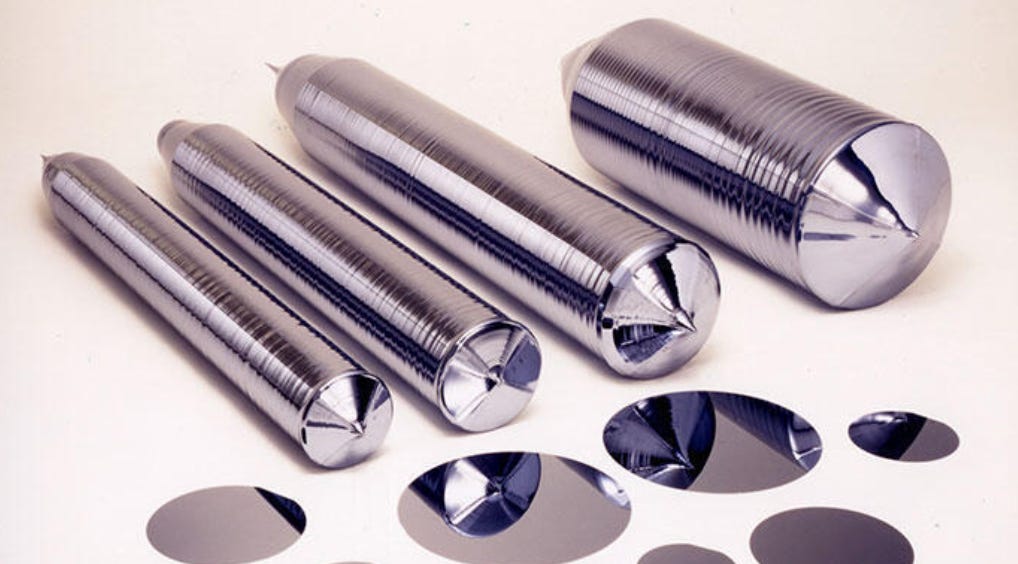
Wafers generally are either 150mm, 200mm or 300mm in diameter (300mm are used for more leading age applications). Normal wafers are used for simple logic chips and Epi (epitaxial) wafers have a special extra pure crystal grown layer on top which ultra clean and suitable for more complex processors and chips.
Different specifications of crystal for end customers are determined by the recipe of polysilicon (which is melted) and seed silicon (which is dipped into the molten polysilicon (while rotating). The wafer “ingot” that is “pulled” out is top and bottom sliced and then thinly cut into wafers. The wafers are then cleaned, polished, chemically “etched” and then either packaged or given an "epitaxial” layer and then sent off to the customer. The more “complex” the recipe, and the more “high end” the spec, the higher the price. Top of the range GPUs and processors obviously merit the highest quality leading edge wafers. But to be able to sell those wafers companies need to go through an arduous qualification process. No-one is incentivised to put a “Rolls-Royce” chip on a cheap wafer given that the wafers represent a tiny fraction of the end price and getting it wrong would ruin the chip. On that basis the top 5 players dominate the market and the qualification process from the major fabs/foundries represents a high barrier to entry.
Wafers are essentially the most “upstream” part of the semiconductor manufacturing process. Historically the wafer companies have been pushed and pulled into building extra capacity through long term arrangements which then often leave that capacity lying fallow when there is an inventory glut. Such a glut currently persists in the market given the major capex programme of many players to expand capacity in the early 2020s and earlier. A good summary comes from Sumco’s Q2 2026 presentation:
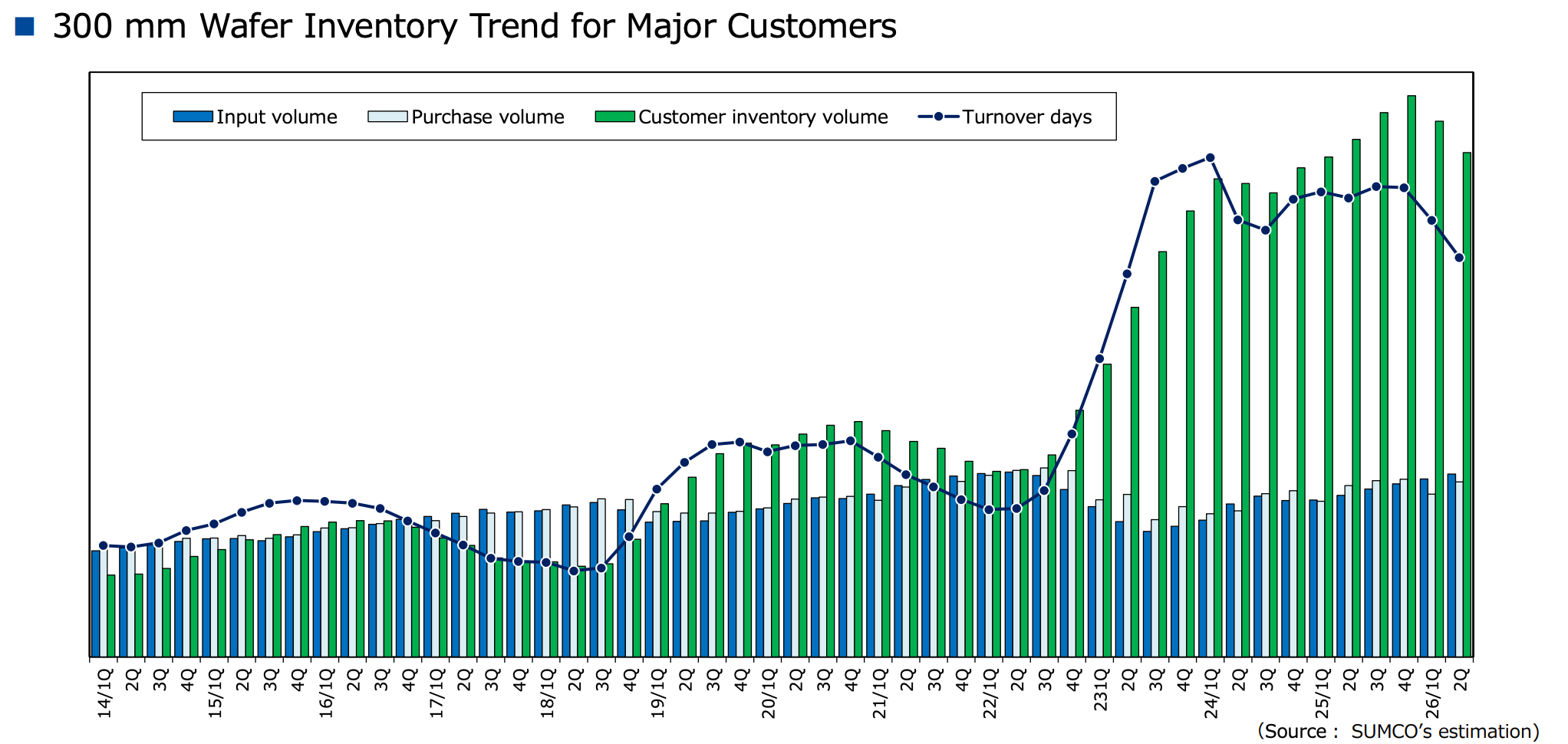
As we can see, the inventory build has been quite pronounced from 2022 to the present, as we begin to see inventories peak. Now we have had two successive quarters confirming an inventory peak and decline, suggesting the market is now tightening. Logic, in particular, appears to be tightening rapidly:
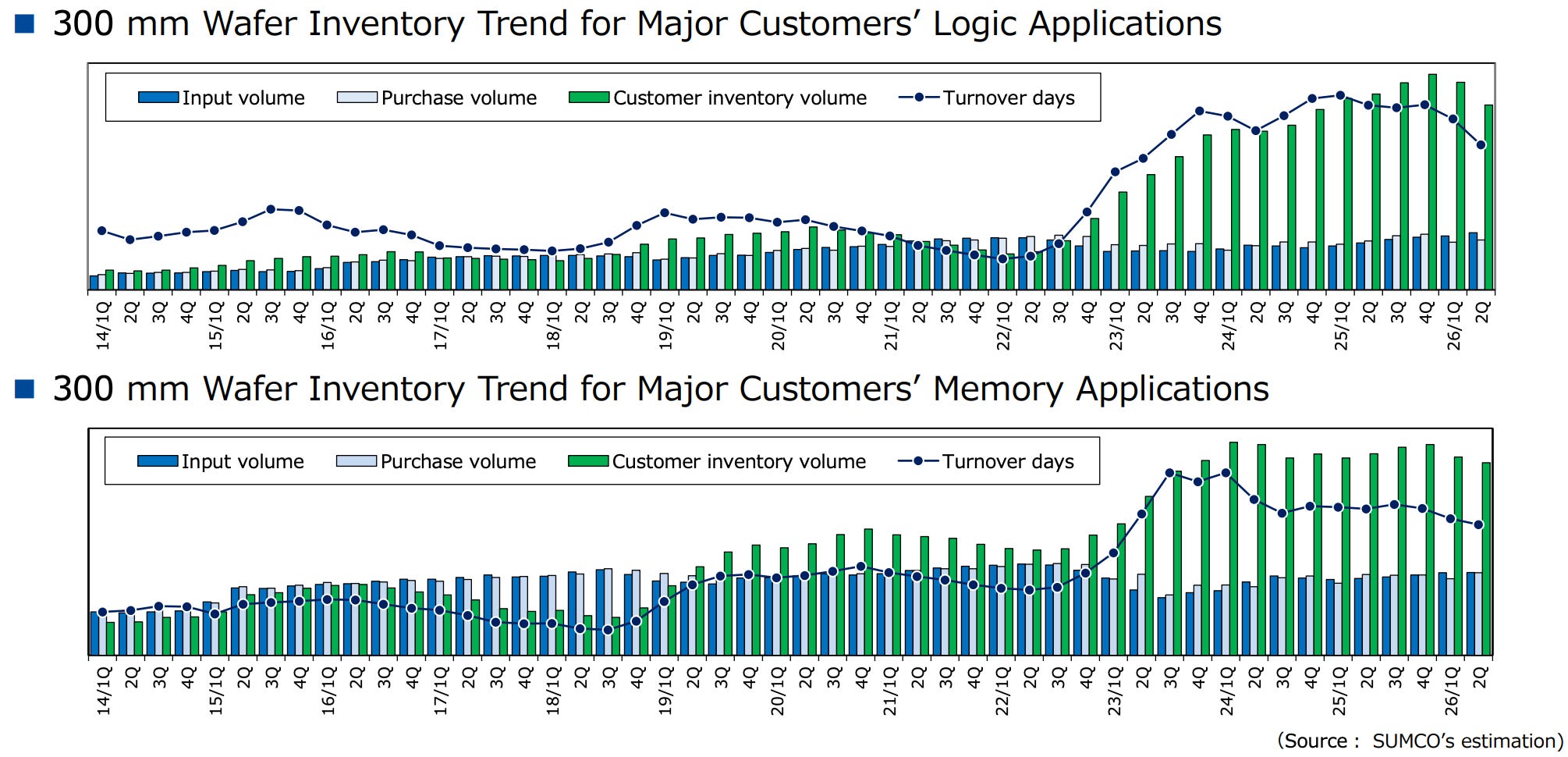
Sumco point to strong 300mm demand for AI use but lagging demand from memory and non-leading edge logic, although as we have seen, NAND demand is projected to tick up.
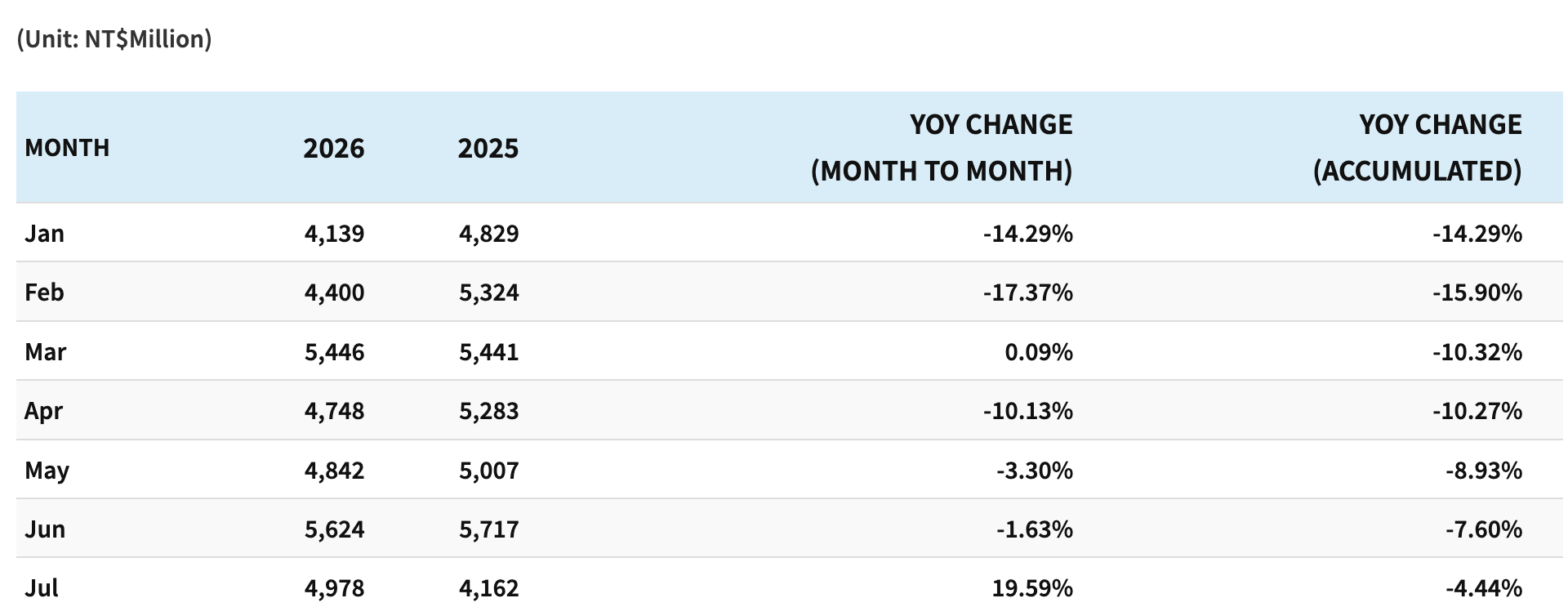
It isn’t just Sumco: peer Globalwafers is seeing improving year on year revenue growth trends on a monthly basis with July (unreported elsewhere) showing particular strength):
For the main companies where wafer margins are identifiable, EBITDA margins are at a low ebb: 27% in the case of Sumco (from 23.1% in Q1), 25% in the case of Globalwafer and 21.6% for Siltronic. Siltronic’s capital employed sits around €3bn currently with its annualised operating profit of -€210m, in other words a return on capital employed of -7%. Contrast with Globalwafer’s annualised ROCE (operating profit basis) of approx. 5% at a cyclical low. Given the “freshness” of new capacity at its Singapore facility and the fact that it is governed by LTA’s you would expect that Siltronic would at least be earning a cost-of-capital return on its recent capex. But deferrals and delays to take or pay arrangements have meant that capacity is underutilised (perhaps as low as 30%-40% utilisation).
After the paywall jump we sketch out some returns/valuation scenarios and explain why Siltronic stands out…
